

How To Come Up With A Clean Brochure

How to implement Clean Architecture with Laravel
Uncle Bob's Clean Architecture is quite the hype correct now in the architects' world. Merely when information technology comes to actual implementations, cipher notable has been proposed for Laravel.
And that's understandable: Laravel's MVC architecture and its tendency to let you cross layers all the time using Facades doesn't help designing make clean, decoupled software parts.
And so today, I'm going to nowadays y'all a working implementation of the Clean Architecture principles inside a Laravel app, as explained in The Clean Architecture by Robert C. Martin.
The complete, working implementation of the concepts explained hither is bachelor on my GitHub repository. I recommend you lot have a expect at the actual code while reading this article.
For one time, permit'south get our hands clean 👍
It all started with a diagram
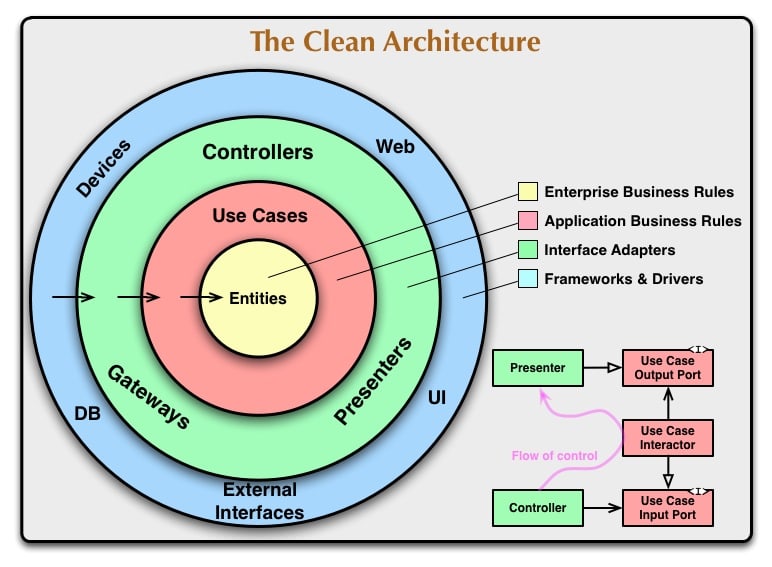
The architecture must back up the apply cases. [...] This is the first business of the builder, and the first priority of the architecture.
(The Clean Architecture chapter 16, p148.)
If you've never heard of utilise cases, you tin can retrieve of it as a feature, the chapters of a system to exercise something meaningful. UML let you draw them using the well-named Use Case Diagrams.
In CA, use-cases are at the middle of the awarding. They're the microchip that controls the machinery of your app.
So, how are we supposed to implement those use cases so?
Glad you asked! Here's a second diagram:

Let me explicate briefly, and we'll dive into the actual lawmaking.
The pink line is the menses of control; it represents the order in which the different components are existence executed. First, the user changes something on the view (for example, he submits a registration course). This interaction becomes a Asking object. The controller reads it and produces a RequestModel to be used by the UseCaseInteractor.
The UseCaseInteractor then does its thing (for case, creates the new user), prepares a response in the course of a ResponseModel, and passes it to the Presenter. Which in plough updates the view through a ViewModel.
Wow, that'south a lot 😵 That's probably the main criticism made to CA; it'due south lenghty!
The phone call hierarchy looks like this:
Controller(Request) ⤷ Interactor(RequestModel) ⤷ Presenter(ResponseModel) ⤷ ViewModel
What nigh the ports?
I can meet you're quite the observer! For the depression lever layers (the Utilize Cases and the Entities, often referred to as the Domain, and represented as the cherry and yellow circles in the schema in a higher place) to be decoupled from the high-level layers (the framework, represented as the blue circle), we demand adapters (the green circle). Their job is to convey messages between high and low layers using their respective API and contracts (or interfaces).
Adapters are admittedly crucial in CA. They guarantee that changes in the framework won't require changes in the domain and vice-versa. In CA, we want our employ cases to be abstracted from the framework (the actual implementation) so that both tin modify at volition without propagating the changes on other layers.
A traditional PHP/HTML application designed with clean architecture can therefore be transformed into a REST API just past changing its controllers and presenters - the Employ Cases would remain untouched! Or you could have both HTML + Remainder next using the same Apply Cases. That'due south pretty groovy if you inquire me 🤩
To do that, we demand to "force" the adapter to "deport" the way each layer needs it to behave. We're going to utilise interfaces to define inputs and output ports. They say, in essence, "if you lot want to talk to me, you're going to take to do it this way!"
Apathetic blah apathetic. I want to see some code!
Since the UseCaseInteractor will be at the heart of everything, let'southward showtime with this i:
grade CreateUserInteractor implements CreateUserInputPort { public role __construct ( private CreateUserOutputPort $output , private UserRepository $repository , private UserFactory $factory , ) { } public function createUser ( CreateUserRequestModel $request ): ViewModel { /* @var UserEntity */ $user = $this -> factory -> brand ([ 'name' => $asking -> getName (), 'email' => $asking -> getEmail (), ]); if ( $this -> repository -> exists ( $user )) { return $this -> output -> userAlreadyExists ( new CreateUserResponseModel ( $user ) ); } try { $user = $this -> repository -> create ( $user , new PasswordValueObject ( $request -> getPassword ()) ); } catch ( \ Exception $e ) { return $this -> output -> unableToCreateUser ( new CreateUserResponseModel ( $user ), $due east ); } render $this -> output -> userCreated ( new CreateUserResponseModel ( $user ) ); } }
There are iii things nosotros need to pay attention to hither:
- The interactor implements the
CreateUserInputPortinterface, - The interactor depends on the
CreateUserOutputPort, - The interactor doesn't make the
ViewModelhimself, instead it tells the presenter to do it,
Since the Presenter (abstracted here by CreateUserOutputPort) is located in the adapters (green) layer, calling it from the CreateUserInteractor is indeed an fantabulous example of inversion of command: the framework isn't decision-making the utilise cases, the use cases are controlling the framework.
If you observe it likewise boringly complicated, forget all that and consider that all the meaningful decisions are being fabricated at the use case level - including choosing the response path (userCreated, userAlreadyExists, or unableToCreateUSer). The controller and the presenters are but obedient slaves, devoid of business logic.
We tin can never rehearse information technology enough so sing information technology with me: CONTROLLERS 👏 SHOULD 👏 Not 👏 Comprise 👏 BUSINESS 👏 LOGIC 👏
So how does it look from the controller's perspective?
For the controller, life is simple:
class CreateUserController extends Controller { public function __construct ( private CreateUserInputPort $interactor , ) { } public function __invoke ( CreateUserRequest $request ) { $viewModel = $this -> interactor -> createUser ( new CreateUserRequestModel ( $request -> validated ()) ); return $viewModel -> getResponse (); } }
You can meet it relies on the CreateUserInputPort abstraction instead of the actual CreateUserInteractor implementation. It gives us the flexibility to change the use instance at volition and make the controller testable. More on that later.
Okay, that's very elementary and stupid indeed. What about the presenter?
Again, very straightforward:
class CreateUserHttpPresenter implements CreateUserOutputPort { public function userCreated ( CreateUserResponseModel $model ): ViewModel { render new HttpResponseViewModel ( app ( 'view' ) -> make ( 'user.bear witness' ) -> with ([ 'user' => $model -> getUser ()]) ); } public function userAlreadyExists ( CreateUserResponseModel $model ): ViewModel { return new HttpResponseViewModel ( app ( 'redirect' ) -> road ( 'user.create' ) -> withErrors ([ 'create-user' => "User { $model -> getUser () -> getEmail () } alreay exists." ]) ); } public function unableToCreateUser ( CreateUserResponseModel $model , \ Throwable $eastward ) : ViewModel { if ( config ( 'app.debug' )) { // rethrow and let Laravel display the mistake throw $e ; } return new HttpResponseViewModel ( app ( 'redirect' ) -> route ( 'user.create' ) -> withErrors ([ 'create-user' => "Mistake occured while creating user { $model -> getUser () -> getName () } " ]) ); } }
Traditionally, all that code would have been ifs at the controller's end. Which would have forced the use example to find a way to "tell" the controller what happened (using $user->wasRecentlyCreated or by throwing exceptions, for instance.)
Using presenters controlled by the use case allows usa to choose and alter the outcomes without touching the controller. How great is that?
So everything relies on abstractions, I imagine the container is going get involved at some point?
You're absolutely right, my good friend! It pleases me to exist in good visitor today.
Here's how to wire all that in app/Providers/AppServiceProvider.php:
class AppServiceProvider extends ServiceProvider { /** * Annals any awarding services. * * @render void */ public function register () { // wire the CreateUser use case to HTTP $this -> app -> when ( CreateUserController :: form ) -> needs ( CreateUserInputPort :: class ) -> give ( part ( $app ) { return $app -> make ( CreateUserInteractor :: class , [ 'output' => $app -> brand ( CreateUserHttpPresenter :: form ), ]); }); // wire the CreateUser utilise case to CLI $this -> app -> when ( CreateUserCommand :: class ) -> needs ( CreateUserInputPort :: class ) -> requite ( function ( $app ) { render $app -> make ( CreateUserInteractor :: grade , [ 'output' => $app -> make ( CreateUserCliPresenter :: grade ), ]); }); } }
I added the CLI variant to demonstrate how easy information technology is to bandy the presenter to brand the use example return different ViewModel instances. Take a wait a the actual implementation for more details 👍
Can I test this?
Oh my! It'south begging you to! Another proficient thing about CA is that it relies so much on abstractions it makes testing a breeze.
class CreateUserUseCaseTest extends TestCase { use ProvidesUsers ; /** * @dataProvider userDataProvider */ public function testInteractor ( array $data ) { ( new CreateUserInteractor ( $this -> mockCreateUserPresenter ( $responseModel ), $this -> mockUserRepository ( exists : false ), $this -> mockUserFactory ( $this -> mockUserEntity ( $data )), )) -> createUser ( $this -> mockRequestModel ( $data ) ); $this -> assertUserMatches ( $data , $responseModel -> getUser ()); } }
The complete test class is available here.
I use Mockery for, well, mocking, but it will piece of work with anything. It might seem like a lot of lawmaking, but information technology'southward actually quite simple to write, and information technology volition give y'all 100% coverage of your utilize cases effortlessly.
Isn't this implementation slightly different from the book?
Yes, information technology is. Yous encounter CA has been designed by Java people. And, in most cases, in a Coffee plan, if y'all want to update the view, you can do so directly from the Presenter.
But non in PHP. Considering nosotros don't fully control the view and because the frameworks are structured around the concept of controllers returning a response.
And so I had to adapt the principles and make the ViewModel climb the telephone call stack up to the controller to return a proper response. If you can come up up with a amend design, delight allow me know in the comments 🙏
Would you delight allow me know what you think in the comments? Your opinion matters to me, for I write those articles to challenge my vision and larn new things every day.
You lot are, of course, welcome to suggest changes to the demo repository by submitting a pull-request. Your contribution is much appreciated 🙏
This article took me four days of inquiry, implementation, testing, and writing. I would really appreciate a like, a follow, and maybe a share on your social networks 🙏
Thanks, guys, you contribution helps to keep me motivated to write more articles for you 👍
Further reading:
- Clean Coder Blog
- Entity-Command-Boundary
- Clean Architecture: Use instance containing the presenter or returning data?
- A push, as a "Clean Compages" plugin
- UML Diagrams cheatsheet

Source: https://dev.to/bdelespierre/how-to-implement-clean-architecture-with-laravel-2f2i
Posted by: phillipsshater.blogspot.com
0 Response to "How To Come Up With A Clean Brochure"
Post a Comment